
Laboratory integration case study
Automated HL7 laboratory result export to Google Drive
MPED first connected a laboratory analyser at a private Birmingham laboratory to a protected local integration service that receives device-generated HL7 results, processes them reliably and exports structured files to Google Drive. Following successful commissioning, the same deployment model was rolled out to a London laboratory in the same diagnostic network.
Project at a glance
- Client profile
- Private diagnostic laboratory network
- Location
- Birmingham and London, UK
- Engagement
- Multi-site laboratory system integration
- Data flow
- Laboratory analyser to Google Drive
Clinical context
Challenge
The original Birmingham laboratory operated an analyser capable of producing diagnostic results and exporting them as PDF files. Although the device offered laboratory-system connectivity, the site did not use a full LIS. The requirement was focused: results needed to move automatically from the analyser into a remote Google Drive folder without introducing an unnecessarily large platform or another manual export process. The workflow also had to preserve received messages, prevent duplicate output, recover safely after interruption and provide clear processing evidence. Once the Birmingham implementation was commissioned, the organisation needed the same focused workflow at its London laboratory.
Delivery response
Solution
MPED initially deployed a focused version of the MPED InterLabs platform on a Windows workstation at the Birmingham site. The service receives HL7 result messages directly from the laboratory analyser, validates and stores them durably, maps the required result fields and produces structured CSV files for delivery into a dedicated Google Drive folder. During commissioning, MPED adapted the integration to the analyser’s actual communication method and local network behaviour rather than relying only on the supplied specification. The validated deployment model was subsequently rolled out to the network’s London laboratory.
From analyser to cloud
Delivery scope
The engagement covered the complete local processing path, production deployment and validation for the original Birmingham site, followed by rollout to the network’s London laboratory.
- Review of the analyser documentation and HL7 interface specification
- Preparation of a site-specific MPED InterLabs production release
- Installation as an automatically starting Windows service
- Direct network connection between the analyser and the integration host
- Reception, parsing and validation of analyser-generated HL7 messages
- Durable acceptance before a successful acknowledgement is returned
- Mapping of individual assay targets into structured result rows
- Deterministic CSV generation and delivery to Google Drive
- Duplicate suppression and retry handling for unavailable output
- Protected diagnostic archiving and local health monitoring
On-site engineering
Adapting to the analyser’s real network behaviour
The documentation suggested a conventional HL7 connection, but the physical analyser behaved differently during commissioning.
- The analyser sent one complete HL7 message per UDP datagram
- MPED added and commissioned a compatible UDP receiving path
- The direct device connection was restricted to the relevant local interface
- A controlled address-assignment mechanism stabilised the analyser connection
- TCP/MLLP capability remained available for other deployment scenarios
- The clinic package excluded demonstration tools and synthetic message generators
Processing workflow
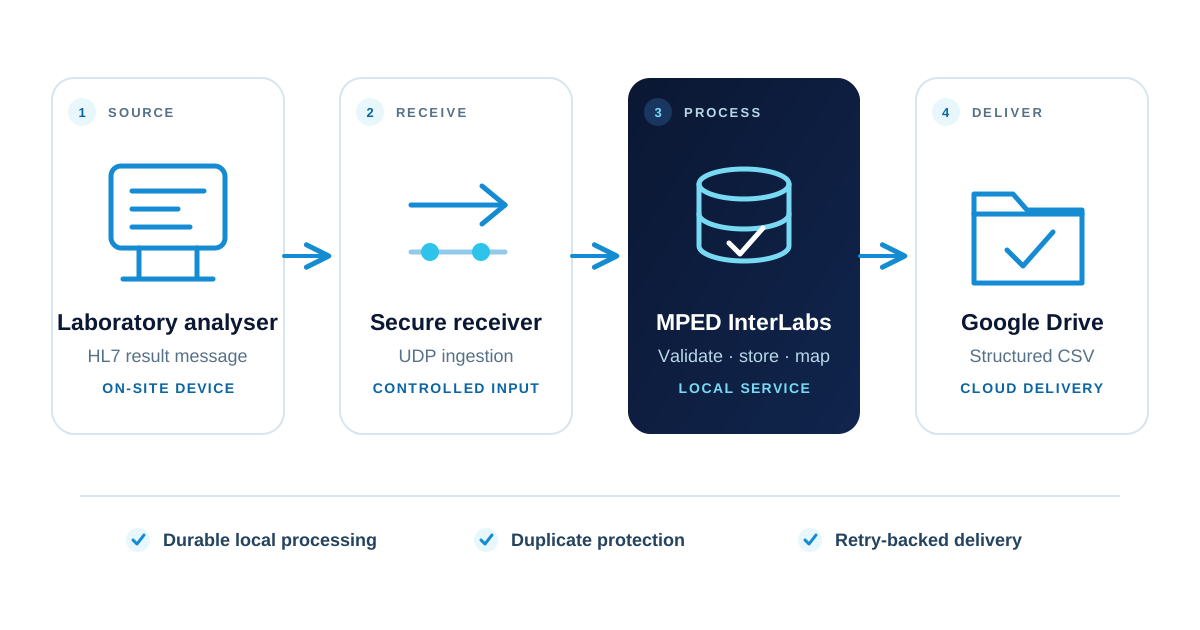
From a device-generated result to a structured cloud file
The production path combines protected receipt, durable processing, controlled mapping and retry-backed delivery.
Engineering detail
Technical specifications
The implementation was designed for durable local operation, controlled handling of medical messages and supportable recovery.
- HL7 laboratory result processing for device-generated messages
- UDP reception for the commissioned analyser with TCP/MLLP capability retained
- Durable SQLite-backed acceptance and processing state
- Idempotent processing and duplicate suppression
- Retry-backed export queue for temporary destination failures
- Structured CSV output with deterministic filenames
- Google Drive for Desktop delivery through a controlled local bridge
- Protected raw-message archive with configurable retention
- Local-only health and operational status checks
Commissioning evidence
Results
- At the Birmingham site, three existing results were transmitted from the physical laboratory analyser
- All three HL7 messages were received, parsed and durably accepted
- Each message mapped into nine structured target results
- Three deterministic CSV files were created and delivered to Google Drive
- Duplicate-safe processing and service restart recovery were verified
- The export backlog returned to zero with no failed exports remaining
- Raw medical message content was excluded from normal application logs
- The validated Birmingham implementation was subsequently rolled out to a second laboratory site in London
Summary
A repeatable laboratory integration deployed across two UK locations
MPED delivered a practical alternative to introducing a full laboratory information system for a diagnostic network that needed a specific device-to-cloud workflow. The integration receives results directly from the laboratory analyser, processes them through a durable and duplicate-safe pipeline, and delivers structured files to the organisation’s existing Google Drive environment. After adapting and validating the system during the original Birmingham commissioning, MPED used the proven deployment model for a second laboratory in London.